
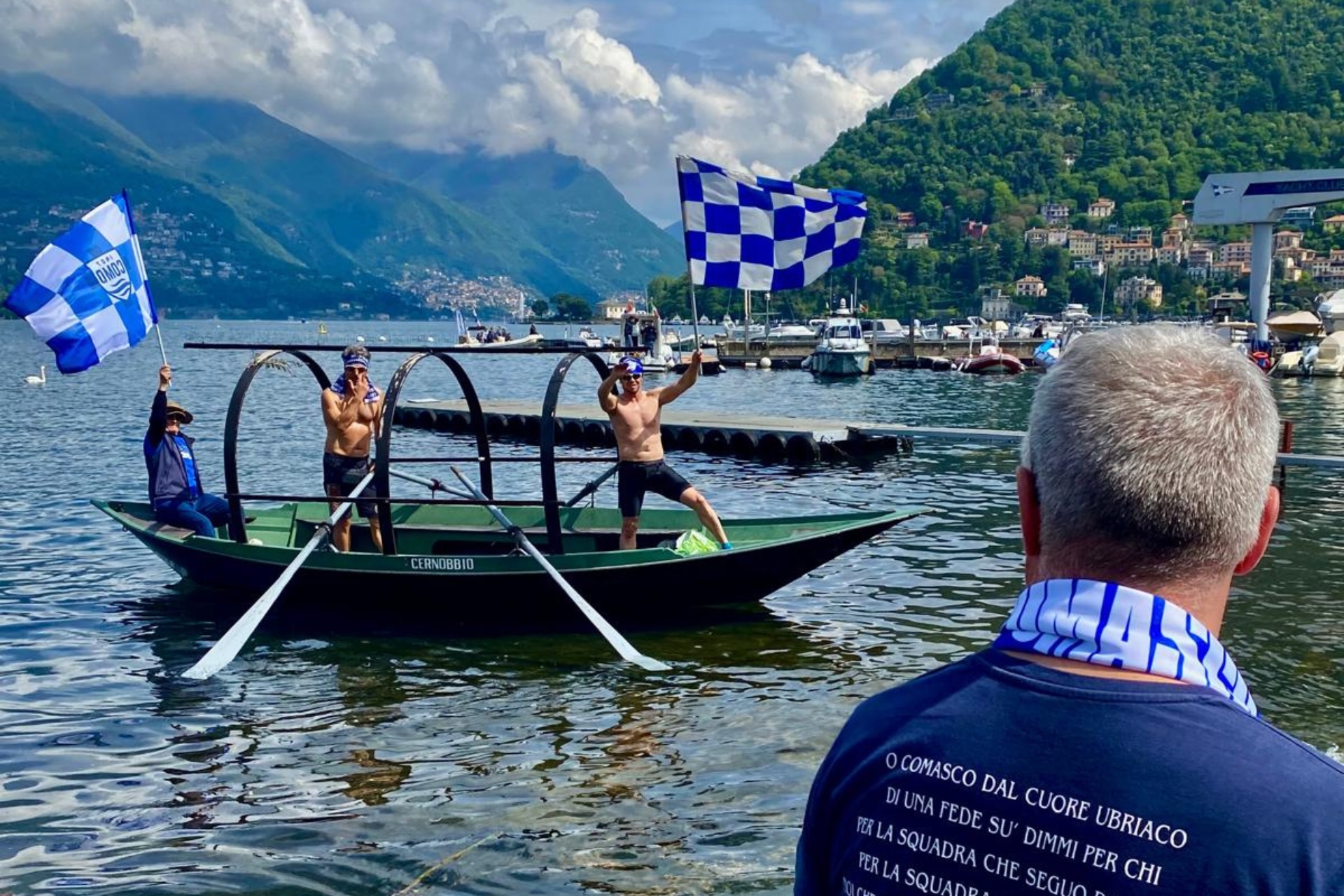
If you have been by the water on a home match day, you have probably seen it before you heard it. A small boat cutting across the lake, a burst of blue and white, flags snapping in the breeze. Three figures aboard, one of them standing tall at the prow with a chequered flag held like a signal flare.
In the photos, it looks almost staged. In reality, it is simply Como.
The boat is a Lucia, the traditional Larian rowing boat more formally known as a batèl, recognised by its long, slim hull and the curved wooden arches that once held a protective cover for fishermen spending long hours out on the lake. Over time, it became known as the Lucia because of its connection to I promessi sposi by Alessandro Manzoni, where an escape across the lake fixed the image of this kind of boat in the cultural memory of the area.
Today, that same silhouette turns up in postcards, local regattas and rowing traditions like the Palio del Lario, and in the work of groups who preserve the Lucie Manzoniane as living heritage, not museum pieces.
And now it turns up in Como colours.
The idea belongs to Adriano Sala, known locally as the Inventor, an eighty year old with the kind of energy that makes retirement sound like a new schedule, not a finish line. Alongside him are his son Moris and their friend Paolo Liboni, both triathletes, both as happy with effort as they are with celebration.
Together they call themselves Laghee de la Lucia, and on home match days they row roughly six kilometres across the lake, waving flags as they approach the hangar area before kick off. The point is support, of course. But it is also a gesture of place. A way of saying that football here is never fully separated from the lake, the boats, the shoreline, the people watching from stones and steps.
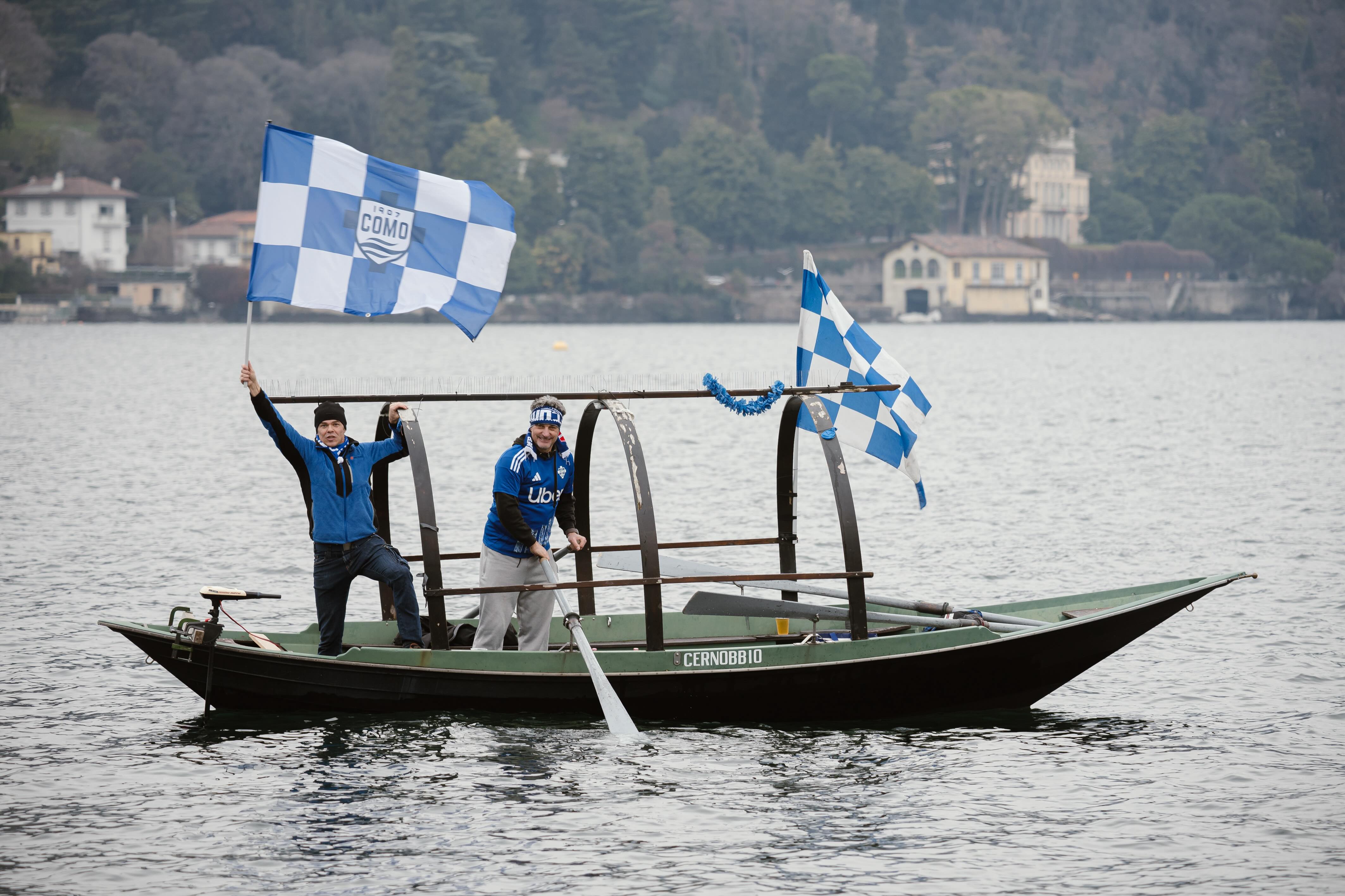
As the images depict, the scenes the Lucia creates lands in full colour. The boat sits low on the water, oars extended, three wooden arches framing the figures onboard. One man holds a Como flag, another lifts the chequered blue and white like a banner. Onshore, a supporter stands in a scarf, watching them arrive as if it is the most normal thing in the world.
Or when the lake is winter grey, the same boat becomes something else. Olive branches are tied near the arches. Ribbons trail. The flag still flies. The ritual does not change with the season, it simply adjusts its palette.
That continuity is part of why this has caught on. It feels rooted, not invented for attention. It is football support with local grammar.
Historically, the batèl was designed for work. Flat bottomed, stable, practical, used to carry fish and goods along the shore to markets and kitchens. The arches were not decoration, they were function, supporting a cover that protected occupants during long trips on the water.
That is what makes the visual twist so satisfying when it appears in biancoblù. It is the same working form, but repurposed into a moving celebration, not in spite of tradition but through it.
It also makes sense in a city where the stadium is woven into the lakefront. Stadio Giuseppe Sinigaglia is one of the few places where you can step out of the turnstiles and be at the water in minutes. So when a boat arrives waving flags, it does not feel like theatre imported from somewhere else. It feels native.
Adriano describes it simply. Retirement is not an endpoint, it is a new starting line. The idea had been in his head for years, but he could not have done it alone. Moris talks about alignment. Following the club’s progress, seeing values match values, feeling the same sense of momentum. Paolo talks about what it feels like on the boat. Listening to Adriano’s stories, learning through proximity, realising that the best support is often built from small repeated actions rather than big declarations.
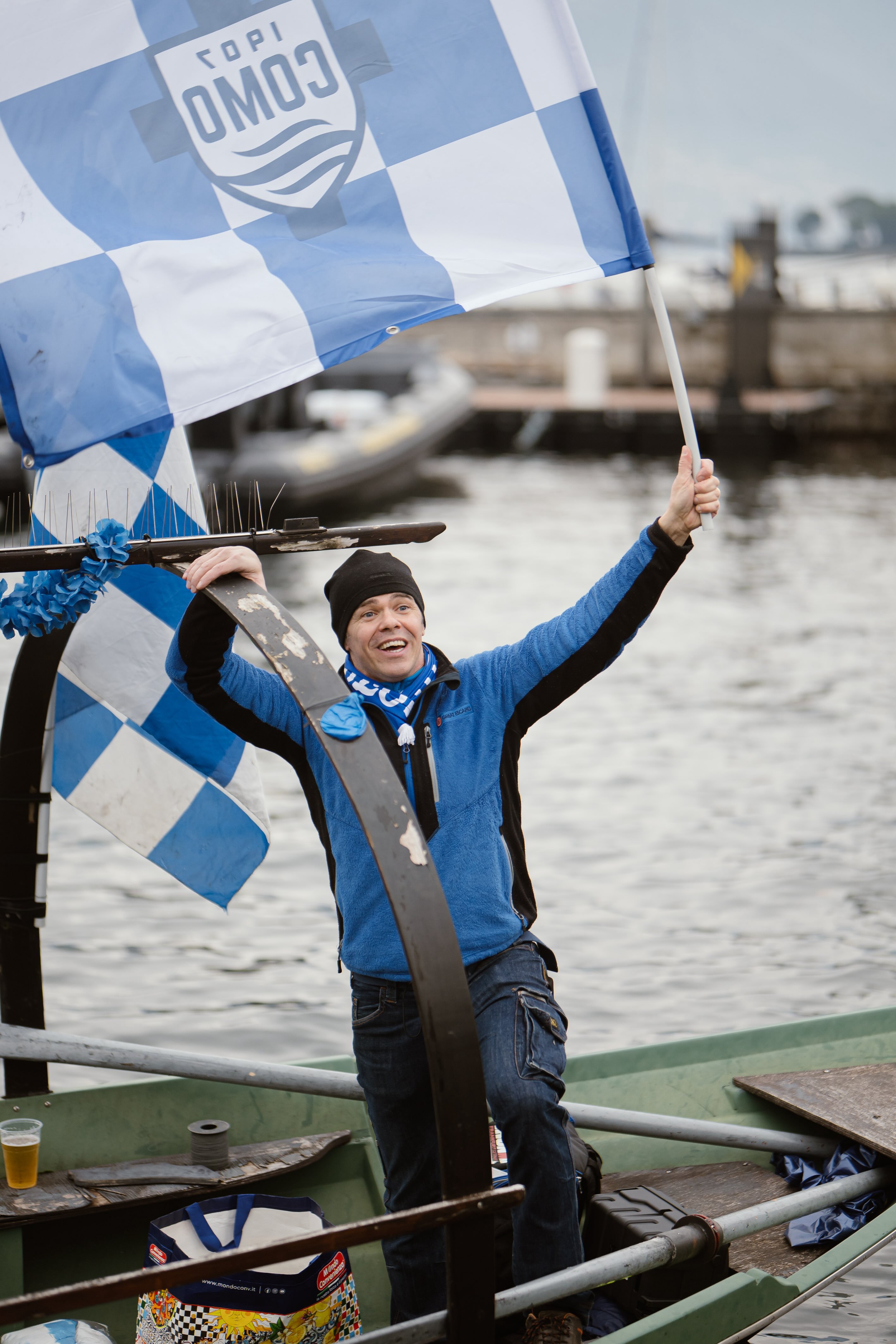
The chemistry is the whole point. Experience and youth, memory and fitness, lake craft and modern endurance. A tiny crew that feels like a mascot for the wider Curva mood: committed, inventive, slightly unrepeatable anywhere else.
There is also a community layer. A Lucia is one of those objects tourists notice immediately, even if they do not know what it is. It is a shape that pulls a phone out of a pocket. It starts conversations. In that sense, the Laghee de la Lucia do something quietly useful: they introduce a piece of local heritage to visitors in the most natural way possible, by using it, not explaining it.
In the end, this is not just about getting near the stadium. It is about making an intergenerational bridge that stays visible from the shore. A reminder that support can be loud without being aggressive, and that the healthiest traditions are the ones that keep moving.
If you see them on the water, you will understand quickly. The flags are only half the message.
The other half is the boat.