
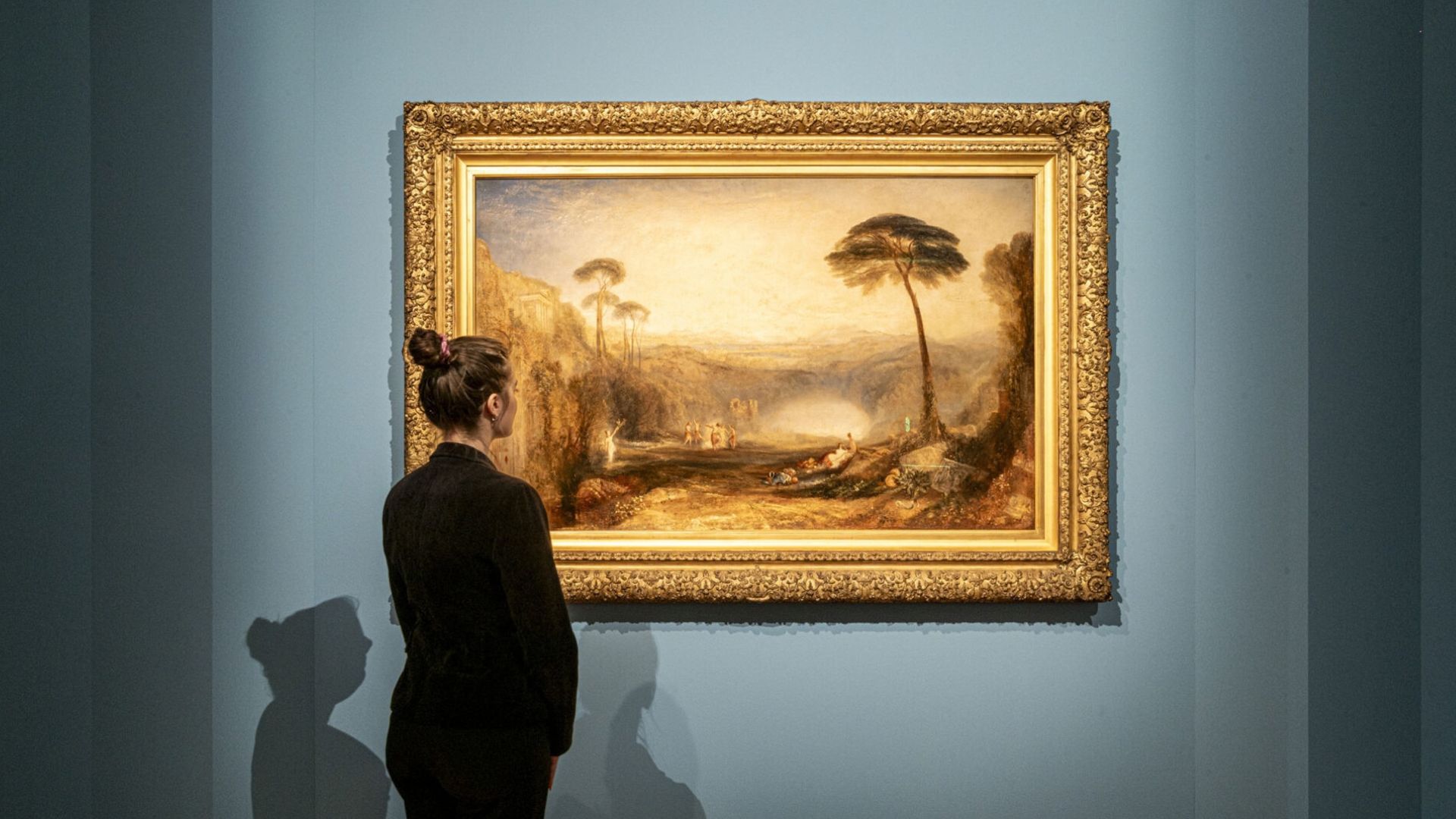
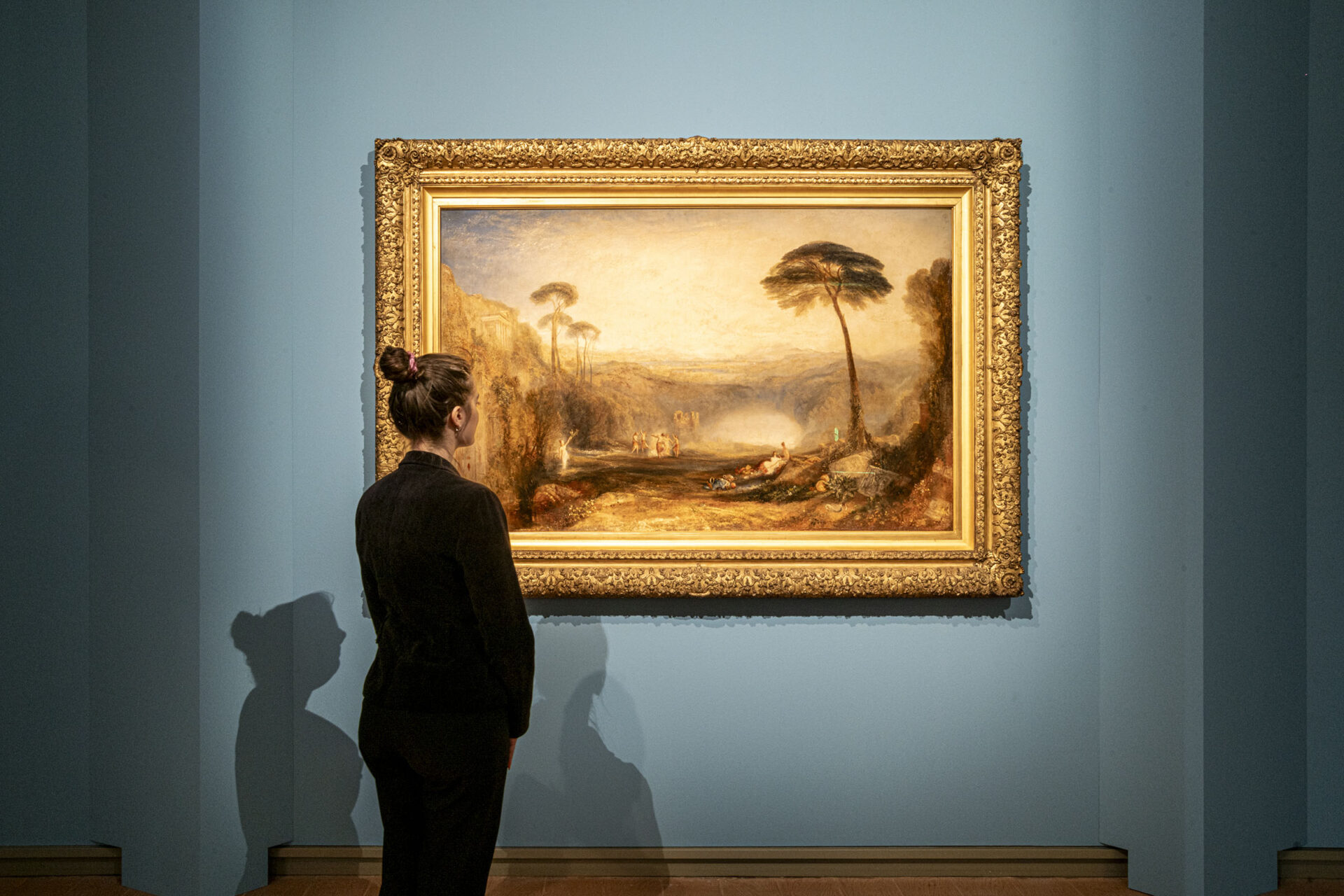
Two centuries before Como became shorthand for escape, J.M.W. Turner came here for something harder to hold: weather, colour and the moment a landscape changes. Now his work has travelled back from London, opening a route through the lake he never stopped trying to catch.
The lake never gives you one face twice. At breakfast it is pale glass. By lunch, metal. Before a storm, the blue goes dark, the mountains disappear at the edges and the view behaves like a dream. People reach for their phone. J.M.W. Turner reached for a sketchbook.
Turner was British painting's weather obsessive. Born in London in 1775, he entered the Royal Academy Schools as a teenager and built a career from rain, fire, mist, sea spray and light pushed beyond recognition. His paintings do not sit politely on the wall. They flare, blur and move. Solid ground begins to feel optional.
That energy returns through Capolavori dalla Tate, created by Como and Tate. Centred on Turner. L'incanto del lago di Como e del paesaggio italiano, it runs across Palazzo del Broletto in Piazza Duomo and the Pinacoteca Civica on Via Diaz. This is not a British artist being dropped into an Italian setting for atmosphere. Como is inside the work. Turner came here, travelled the water, studied the shore and returned across decades.
At the Broletto, seven watercolours move from observation into something electric. Five were made through his journeys, while two were developed for Samuel Rogers's illustrated poem Italy. At the Pinacoteca, four oils widen the frame, including The Golden Bough, Tivoli, from Monte Catillo, The Sun of Venice Going to Sea and Sunset over a Lake. Together, they show an artist letting landscape slip its outlines. Buildings soften. Mountains become colour. Light stops decorating the scene and takes control of it.
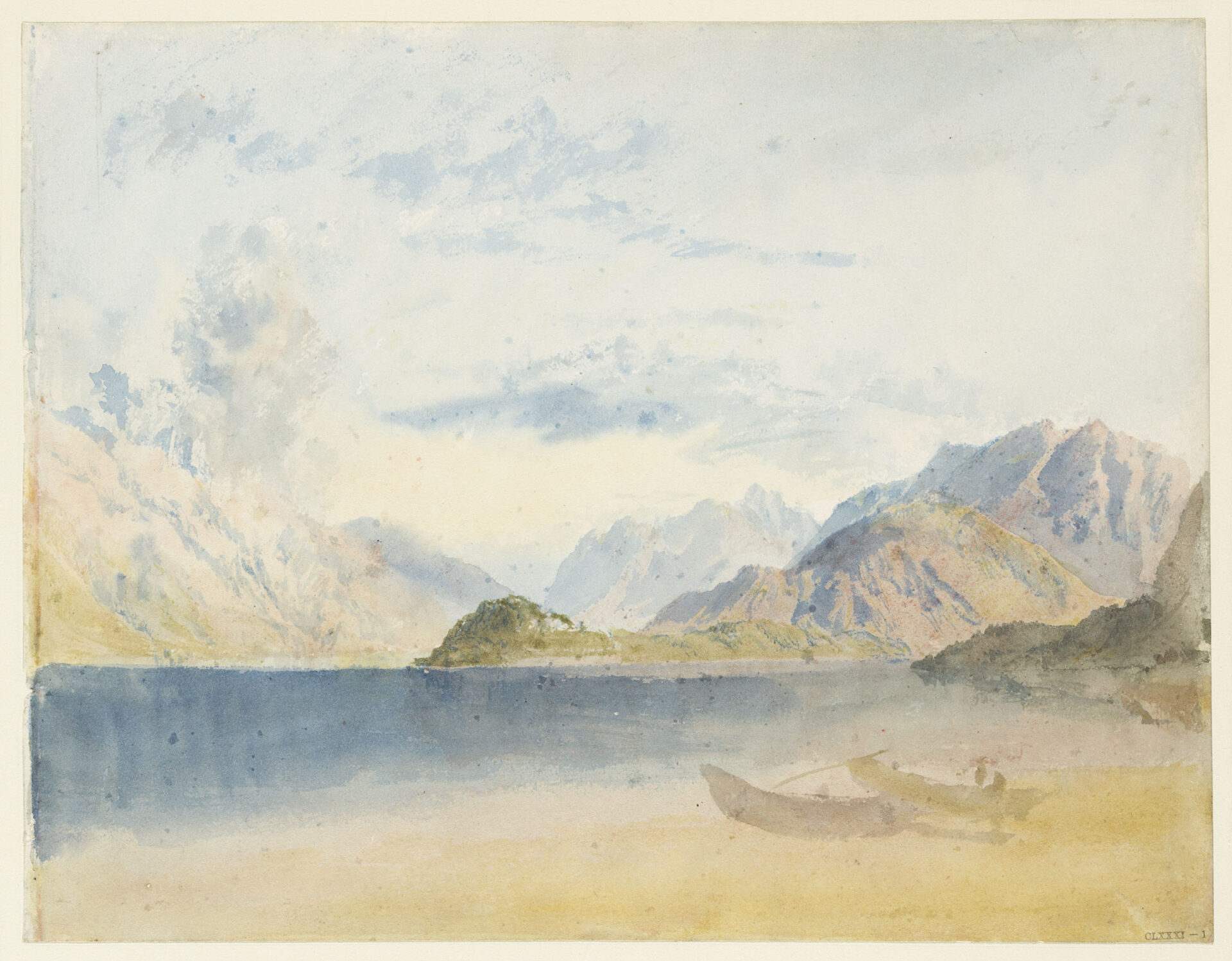
His first encounter with Lake Como came in 1819, on his tour of Italy. Turner travelled like someone afraid the world might change before he could get it down. He sketched from roads, boats, windows and hillsides, filling pages with pencil lines and washes of colour. The 93-folio notebook Turin, Como, Lugarno, Maggiore contains 49 drawings of the Larian landscape. His camera roll. Only every frame was made by hand.
The route is legible. He drew the old port in Como, where Piazza Cavour now opens towards the water, and the Duomo beside the Broletto. He moved past Cernobbio and studied Villa d'Este, then caught the church of Santi Quirico e Giulitta at Carate Urio, the shoreline at Laglio and the stacked drama of Nesso. Further north, he looked from Menaggio towards Bellagio and climbed above the town for a wider view. He was not collecting postcard locations. He was testing what water, altitude and unstable weather could do to vision.
There was glamour in the landscape, but also speed. Turner travelled largely by water and rarely stepped ashore. One exception was Villa d'Este, then connected to Caroline of Brunswick, the estranged wife of Britain's future George IV and one of the most talked about women in Europe. Turner copied an inscription from her monument and drew the villa repeatedly. Even in a sprint, he noticed the details that gave a place its charge.
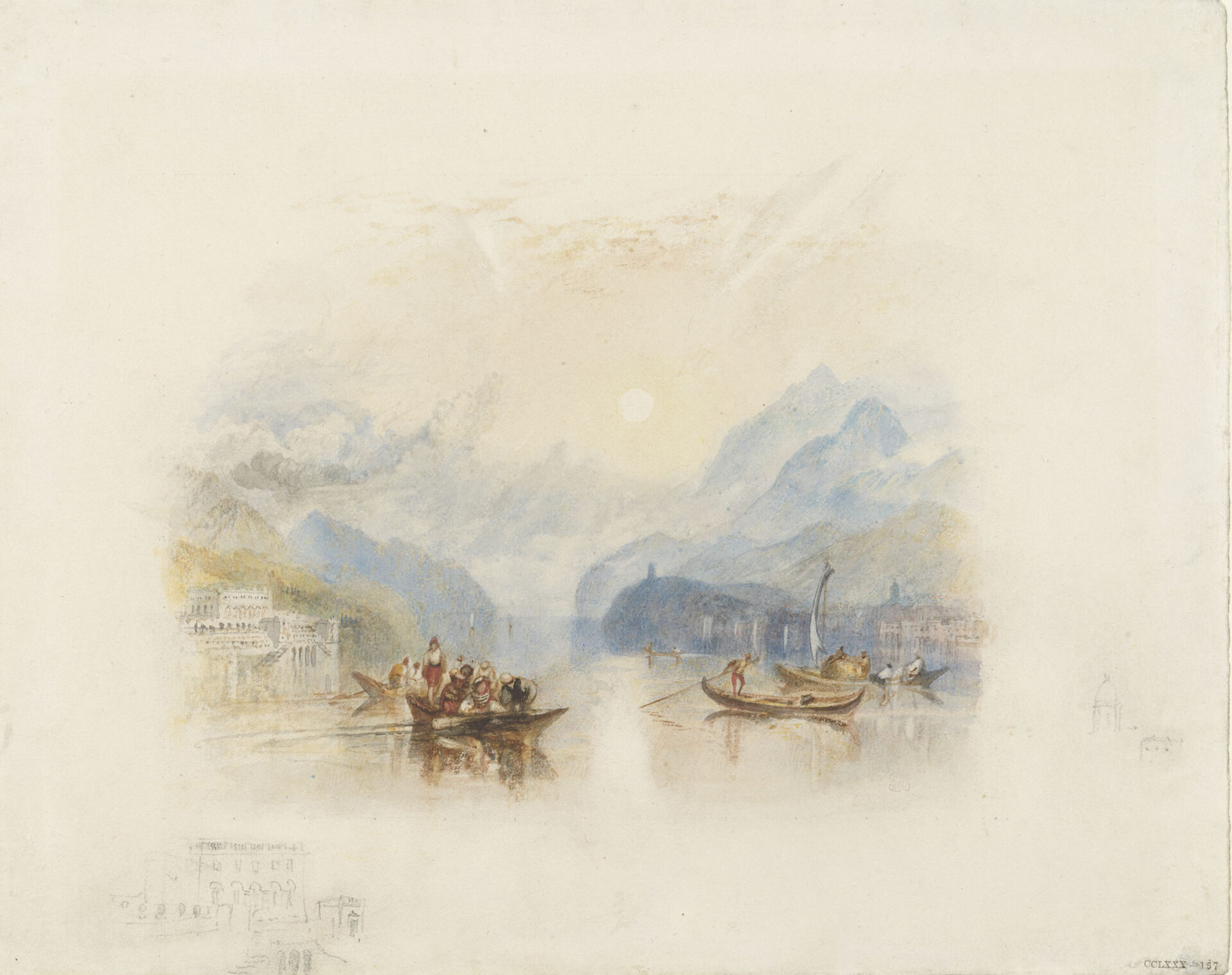
He returned to Como in 1842 and 1843. By then his eye had become more radical. The later watercolours feel less like views than transmissions: a sunset leaking orange into wet paper, a town reduced to blocks of magenta and blue, architecture nearly swallowed by its own reflection. Recent research for the exhibition has even identified a previously mislabelled watercolour as Nesso seen from the lake. The bridge, bell tower and clustered hamlets remain, but Turner turns them into atmosphere. It is recognisable and almost abstract at once.
This is why the work feels unexpectedly current. Turner understood that a landscape is never just geography. It is light, movement, memory and the mood of the person looking. He painted the glitch before the camera existed. He let colour overexpose the image. Critics in his own time sometimes saw unfinished chaos. From here, it looks like freedom.
There is another journey running through the exhibition. As Como 1907 travelled to North London to play at the Emirates Stadium, works from one of London's defining cultural institutions moved in the opposite direction. Football went west. Turner came south. It is a neat exchange between two cities that know how identity can travel without losing its accent.
The best continuation would be to take Turner's pictures back outside. Start at Piazza Cavour, where the old harbour once reached into the city and Turner painted from the Hotel dell'Angelo, later known as the Volta. Stand between the Duomo and the Broletto. Follow the western shore to Villa d'Este and Carate Urio. Cross his line of sight from Menaggio to Bellagio. Approach Nesso from the water, where the village still rises in layers from the lake.
Photographing those viewpoints now should not become a hunt for perfect matches. Como has shifted. The port was filled in, shorelines changed, roads appeared and gardens grew. The weather will refuse to cooperate. That is the point. Put Turner's image beside the present view and the gap becomes part of the story: what survives, what has vanished and what the same light can make unfamiliar again.
The exhibition also pushes colour forward through Jim Lambie and David Batchelor at San Pietro in Atrio. Lambie's vinyl tape floods the floor in bright bands, while Batchelor turns urban materials and acrylic colour into sculpture. Their work is louder, harder edged and built for a different century, but the question is related. How does colour alter a space, and how does a place alter us?
Turner never solved Lake Como, which may be why he kept returning. He drew it as topography, remembered it as poetry and finally let it dissolve into light. Now the pictures have made the same journey back. Step out of the gallery and the original is waiting, already changing. The lake keeps moving.