
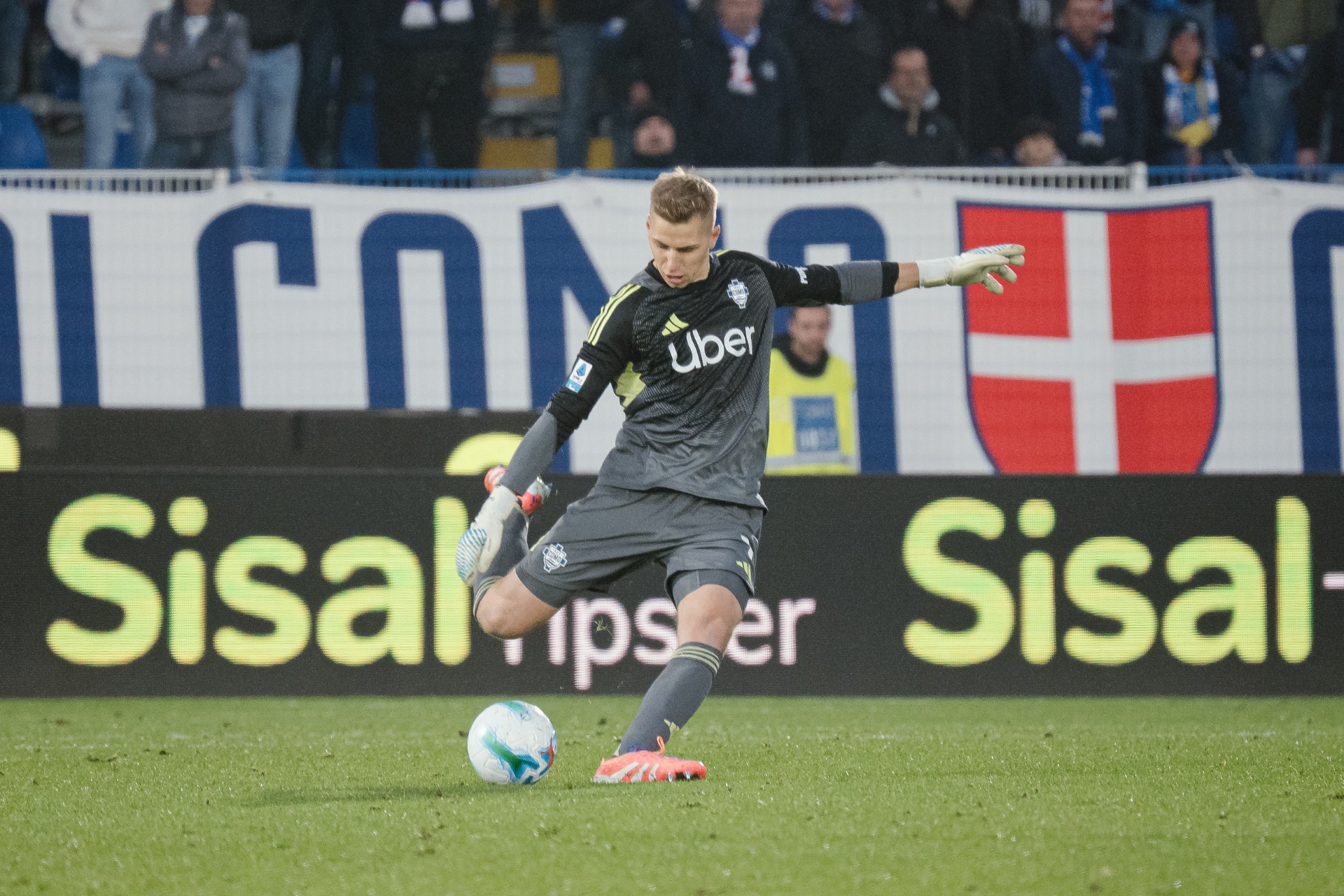
There are goalkeepers who treat the box like a bunker. And there are goalkeepers who treat it like a studio. Same walls, different mindset.
Jean Butez belongs to the second school. Watch him for a few minutes and you see it: the pauses that look like confidence, the first touch that kills panic, the pass that arrives like it was always the plan. He has the build of a traditional keeper, tall, spring loaded, broad shouldered, but the rhythm is modern. He is not waiting for the game to happen to him. He is starting it.
That matters at Como, where the goalkeeper is not just the last line but the first sentence. When Como plays well, the build up often begins with Butez taking a breath, letting the press commit, and then slipping the ball through the noise. You can dress it up as tactics, but it is also temperament. He does not flinch easily. He does not hurry unless the moment demands it. He seems to like control, not in an intense way, more like a quiet preference for things being in the right place.
Butez grew up in Lille, with the kind of football education that teaches you discipline before it teaches you glamour. He spent his formative years in the Lille academy, with a long apprenticeship that included time with the reserve side and the daily understanding that a career is earned, not announced. In France he learned the basics that last: how to work, how to listen, how to stay ready for your moment even when your moment takes time.
Then came Belgium, and something shifted. He went to Mouscron first, initially on loan, and that step mattered because it gave him what goalkeepers crave: ownership. Minutes. Responsibility. The feeling that the net is yours, and whatever happens, you are the one who has to live with it.
When he later moved to Royal Antwerp, he moved into a club that would give him scale. Big games, big expectations, big nights. He became a starter, won trophies, and was part of a season that delivered a domestic treble in Belgium. That kind of success changes how people see you, but it also changes how you see yourself. It sharpens standards. It turns habits into identity.
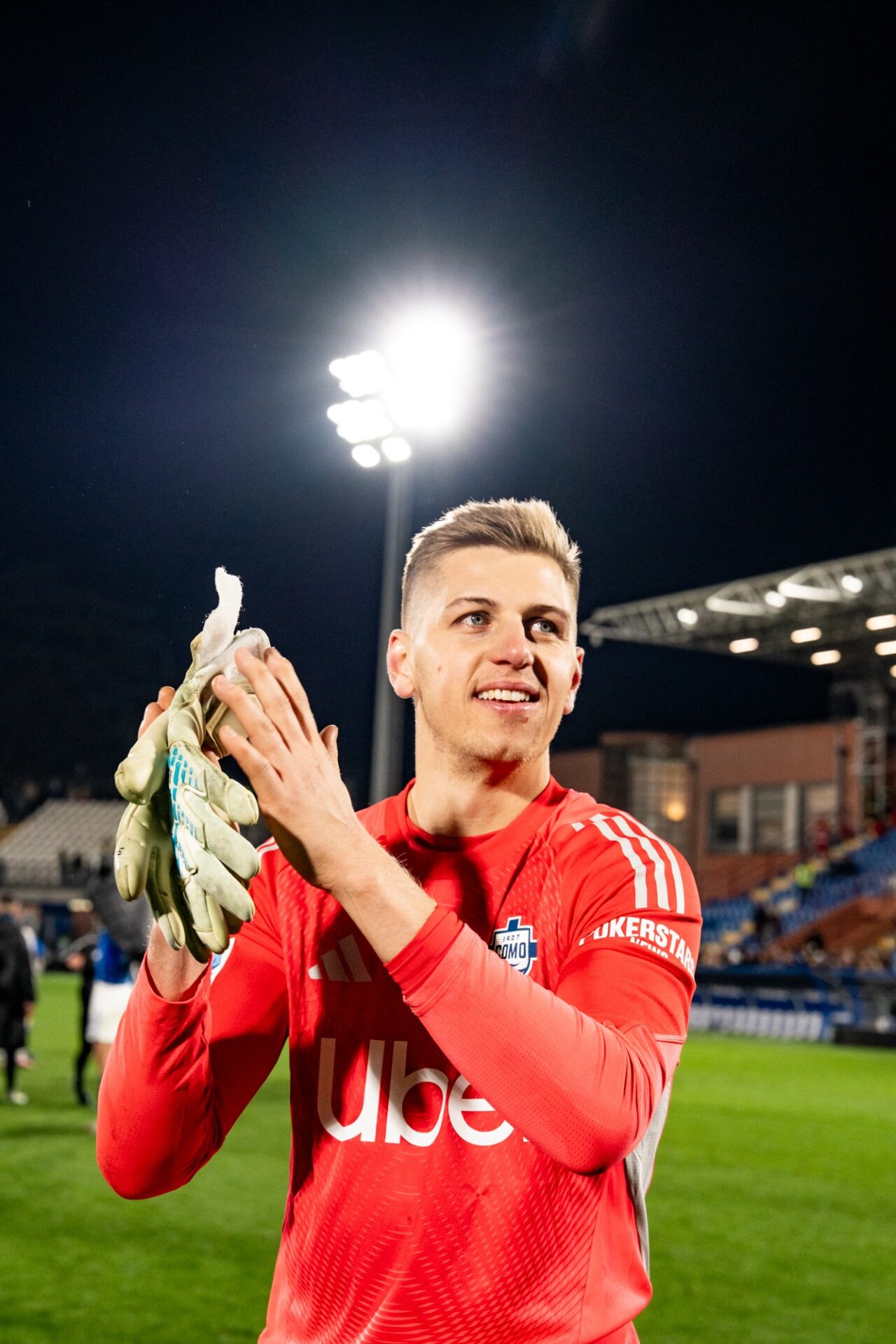
Como came next, on a three year deal, and on paper it looks like a change of league and a change of language. In reality, it is also a change of texture. The lake. The light. The stadium view feels almost unfair. The sense that football can be intense without being grey.
Butez does not pretend the move was only about football. He talks about it like a life decision, which is exactly what it is when you have a family and small children and you are choosing where you want your days to take place.
"My move to another country went well. I needed a change of scenery, a change of environment and to discover a new culture, even though Italian culture is close to French culture. But my family and I needed to discover something new and what better place than Lake Como to flourish both as a family and in an exciting sporting project. So for me it was a real chance to be able to move and then discover something new."
If you want to understand Butez, start with the way he describes his past. He does not talk like a man who has escaped anything. He talks like a man who has collected things.
"My years in France were very important for my development since I spent the ages of 8 to 21 in Lille. So for me, it involved a lot of learning and many important moments, both in the youth teams and through crucial encounters in my career. These are still people I have a lot of contact with today because they helped me become the footballer and the man I am now."
He speaks about France as a foundation. Then he speaks about Belgium as a formation, a place that taught him how to deal with the parts of the job nobody posts about: mistakes, consequences, and the ability to reset.
"The transition between France and Belgium was very smooth, and it was important for me to play as the number one in the first team. It was a real opportunity to be close to Belgium and to be able to play quickly at age 22 in the Belgian first division and learn a lot. On the sporting side, it was a very rapid learning process that still serves me well today because there were some rather difficult moments where I was able to experience a lot: making mistakes, getting a red card... being a bit wrong, which allows me today to be stronger and mentally know how to approach matches with more tranquility and serenity, and also to know how to handle difficult moments correctly."
Then there is the other side of Belgium for him, the part that matters more than football. The family chapter.
"On a human level, it was also very powerful because I was able to get married during this period in Belgium; I married Marion, who has been my wife for several years now. Also, seeing the arrival of our children in Belgium, in Antwerp... these are the most important moments of my life, I would say, which I was able to experience in Antwerp. I think it will always remain a very special city for me after what we experienced as a family and, of course, on a sporting level too, but especially on a family level. It allowed me to grow, to have this responsibility as a father, which once again allows me to be even more serene, even calmer in my goal, and to be a fulfilled man every day with my children around me."
That calm shows up in his day to day choices. Ask him what a perfect evening looks like and he does not sell you a fantasy. He sells you something better: time, properly spent.
"So, an evening with my wife without football and without children is very rare today. We try to grant ourselves some time together every now and then to go to a restaurant or have an evening just the two of us, because it's very important for a couple to have these moments.
To be honest, I don't get the chance to go to the cinema often in Italy, but in France, we used to love going to watch a film at the cinema, having a nice dinner at a restaurant before or after, and then chatting over a drink.
Being able to have time without our phones, without the children, and having true quality moments together, that's what's most important. We met before having kids, and while today we are a family and love our children more than anything, you also have to know how to find each other again without them. It's always very pleasant.
So, I think it would be very simple: an evening with a good movie at the cinema, a nice restaurant, and a good conversation over a drink. That would be the perfect evening, I think."
Then he gives you unexpected talents, and they make perfect sense. Cycling, because he likes speed. Cooking, because he likes the process. The same logic as goalkeeping, just with different equipment.
"One area I'm talented in... it’s still within the realm of sports, but I really enjoy cycling, biking, mountain biking, and road cycling. So, I’d say cycling; I like it a lot, and I’m quite talented at it. I also love the sensation of speed, so it’s something I do whenever I have the time and when I go back to northern France.
Now, that’s within sports. In a field outside of sports, I’d say I enjoy cooking. I prefer cooking at home while my wife bathes the children, rather than the other way around. I like spending time in the kitchen, following a recipe, or preparing a meal I already know how to make.
So, yeah, I’d say cooking is also something I particularly appreciate, and at least that way I can decide what I eat during the week at home. It’s definitely an area I enjoy being involved in as well."
His day off choice is exactly what you would expect from a Frenchman who has fallen for Italy: pizza, but done properly. Sometimes ordered, sometimes made at home, always shared.
"A favorite dish for a day off... I’d say, especially after a match, I really love eating a good pizza, a high quality pizza, especially in Italy.
Usually, I order it, but I also have a wood fired pizza oven at home. I love making pizza with my son, my wife, and the kids; we really enjoy making homemade pizza. So, I’d say pizza is always a convivial moment where we gather as a family, or with friends who came to the match.
Either we order a pizza or, when we have the time to prepare a good dough and have the ingredients, we make the pizzas ourselves. Whether it's handmade or ordered, pizza is always a friendly dish that we can all share together and even invite people over for. So, I’d say pizza is definitely the one."
If he gets a free afternoon, he keeps it simple and social.
"If I had a free afternoon, I think I’d go play Padel with a friend. It’s a sport that you can play with friends and it’s very social. I play it from time to time in Northern France and we've even planned to play it here in Italy with some of the other players; it's a truly convivial sport and it's not too physically intense. So, I'd say spending a good time with friends would be that.
If we were to talk about something non sports related, I'd say showing someone around the city of Lille and eating a local dish from Northern France. That would be a great thing to share with a friend and a way to teach them about the culture of Northern France, which is also very social and centered around sharing."
And if he could learn one skill instantly, he goes straight to the instrument that matches his personality. Calm, measured, precise.
"If I could instantly learn a skill outside of football like an instrument, a language, or cooking, which would I choose? I think it would be playing the piano. I love this musical instrument very much.
I enjoy listening to it before matches, or sometimes even in the car; I listen to piano pieces to calm down and feel a bit more peaceful. I got this from my grandmother, who used to tell me that classical music was important for staying calm."
There is something fitting about a goalkeeper who listens to piano to prepare for chaos. Not superstition. Ritual. A way to set the tempo before the stadium tries to speed you up.
On the pitch, his second season at Como has been one of steady elevation. The simplest measure is the one everyone understands: clean sheets. Without getting lost in dates, the shift from last season to this season is clear in both output and feel. More shutouts, fewer anxious spells, and a growing sense that the back line is moving as one unit. Clean sheets are never one man’s property, but Butez has become central to how Como manage games, not just by stopping shots but by starting phases, using the ball with composure, and making the whole team feel a little less rushed.
You see it in the way he talks. You see it in the way he plays. Calm is not an aesthetic for him. It is a tool.
And when a goalkeeper is calm, the whole team breathes.